
What Does a Waldorf Early Childhood Day Look Like?
Parents often wonder what happens during a typical day in a Waldorf early childhood classroom. They may imagine stories, outdoor play, and creative activities, but they may not yet understand how these experiences fit together or why the rhythm of the day matters.
Want to see this rhythm in action?
At Seacoast Waldorf School, the early childhood day is thoughtfully structured around young children’s developmental needs. It includes time for imaginative play, practical work, movement, rest, nourishment, and connection. Rather than rushing from one activity to the next, children experience a dependable rhythm that helps them feel secure and ready to learn.
A Gentle Beginning
The day begins with a warm welcome from the teacher and time for children to settle into the classroom. Some children may begin playing with friends, while others may need a few quiet moments before joining the group.
This unhurried arrival gives children time to transition from home to school. They learn to greet their teachers, put away their belongings, and become comfortable in the classroom environment.
These simple routines help children develop independence while creating a calm beginning to the day.
Imaginative Play
A significant part of the early childhood day is devoted to open-ended, imaginative play. Children may build a home, create a shop, care for dolls, construct a boat, or transform the classroom into an entirely new world.
The materials are intentionally simple and natural, allowing children to decide what objects will become. A piece of fabric might serve as a blanket, a river, or a cape. Blocks may become a house, a bridge, or a train.
Through this kind of play, children develop language, cooperation, planning, flexibility, and problem-solving. They learn to create ideas, share them with others, and adapt when play changes.
Practical Work
Young children want to participate in meaningful work. In a Waldorf early childhood classroom, practical activities are woven naturally into the day.
Children may help prepare food, wash dishes, sweep, fold cloths, water plants, or arrange materials. These tasks are not treated as busywork. They help children experience themselves as capable contributors to the classroom community.
Practical work also strengthens coordination, concentration, sequencing, and independence. Children learn that their efforts have a real purpose and that caring for the classroom is something everyone shares.
A Shared Meal
Food and mealtimes are an important part of the daily rhythm. Children gather together, help prepare or serve food when appropriate, and practice sitting down for a shared meal.
The food is generally simple, nourishing, and thoughtfully prepared. Depending on the classroom routine, children may enjoy items such as fresh fruit, vegetables, whole grains, soups, or homemade bread.
Shared snacks and meals offer more than physical nourishment. Children practice washing their hands, setting the table, serving themselves, waiting for others, and cleaning up afterward. They also experience the social pleasure of eating together.
These moments help children develop gratitude, healthy habits, and a growing sense of responsibility.
Outdoor Time
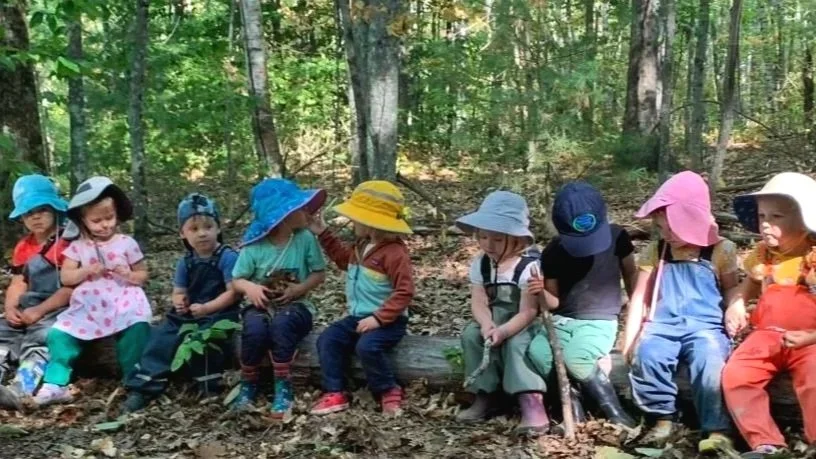
A row of hats, a fallen log, and a forest full of things to notice, an Early Childhood morning at Seacoast Waldorf School.
Outdoor play gives children the opportunity to move their bodies, explore the natural world, and experience the changing seasons. Children may run, climb, dig, balance, build, garden, or observe insects and plants.
Outdoor time supports physical development and helps children become more aware of their surroundings. It also provides opportunities for imaginative play that cannot always happen indoors.
At Seacoast Waldorf School, nature is not simply a backdrop for learning. It is an important part of the children’s daily experience.
Stories, Songs, and Movement
The teacher gathers the children for stories, songs, poems, finger plays, and movement activities. These experiences are often connected to the season or to the children’s classroom life.
Stories strengthen listening, memory, vocabulary, and imagination. Songs and movement help children experience language and rhythm through their whole bodies.
Because these activities occur within a familiar daily rhythm, children gradually learn to anticipate transitions and participate with increasing confidence.
Rest and Quiet
Young children need periods of calm as well as active play. The classroom rhythm includes opportunities to slow down, listen, rest, or engage in quieter activities. A peaceful transition after outdoor play or a shared meal helps children regulate their energy. It also gives them space to process the experiences of the day.
Rest does not always mean sleep. It may involve listening to a story, looking at books, drawing, or simply spending time in a quieter part of the classroom.
The Rhythm of Transitions
We pay a lot of attention to transitions in our Early Childhood classrooms. Moving from one activity to the next is an important part of the rhythm of the day, and we think about how to make those shifts feel calm, predictable, and comfortable for the children.
We often think of the day as a rhythm of breathing in and breathing out. Children might spend time in free play, then come together for circle time. From circle, they may transition outside to play, and later come back in to settle together for a puppet show or story.
The teachers gently signal each transition, often through a familiar song or verse. Rather than suddenly stopping one activity and starting another, the children begin to recognize these cues as a natural shift in the day.
As the year goes on, the children come to know and live into this rhythm. They know what comes next and can trust the familiar patterns of their day. That predictability gives young children a sense of comfort and security, while still leaving plenty of room for play, movement, and discovery.
Conflict and Repair
Conflict is a natural part of being in a classroom with other young children, and we see these moments as opportunities for children to learn how to be with one another.
Our teachers begin by modeling the behavior they want to see. They are always working on themselves: how they speak, how they respond, and how they move through the classroom.
During imaginative play, you may see a teacher sitting nearby in a rocking chair, quietly observing while keeping her hands busy with a simple task. She is paying close attention to what is happening, but she doesn't step in at every disagreement. When it is appropriate, she gives children the space to see if they can work through a conflict on their own.
If they need help, the teacher gently steps in and redirects the situation. Sometimes a child may need a change of activity or a little space to reset. A teacher might send them on a small “mission” with an assistant--perhaps going to the kitchen to check whether the bread is ready in the oven—or find a meaningful task to do together.
The goal is never to shame a child or make them feel badly about what happened. Instead, we help them move through the moment and find a way forward.
Repair is also an important part of this process. If one child hurts another, for example, the child who caused the hurt may be invited to help care for their classmate—perhaps getting some ice to help soothe them. In this way, children begin to experience that their actions affect others and that they can also be part of making things better.
Preparing for the Next Step
A Waldorf early childhood day may look simple from the outside, but it is rich with learning. Children are developing physical coordination while they climb and carry, language while they listen and play, mathematical thinking while they measure and sort, and social understanding while they cooperate with friends.
They are also learning how to care for themselves, contribute to a group, and approach the world with reverence and curiosity.
At Seacoast Waldorf School, the early childhood day is designed to meet children where they are while preparing them for what comes next. Through rhythm, relationship, purposeful work, and play, children build the confidence and capacities that support a strong beginning in kindergarten and beyond.
