
Screen-Free Learning at Seacoast Waldorf
Technology has become a regular part of many children’s school and home lives. In a 2024 federal survey of public schools, 88 percent of schools reported giving every student a laptop or tablet. Many children also encounter screens at an early age; 40 percent having their own tablet by age 2, and children age 8 and under averaging over two hours of screen time daily.
At the same time, educators and school leaders are taking a closer look at how technology has impacted learning and engagement in the classroom. In a 2025 Education Week survey, 56 percent of educators called off-task use of school laptops and tablets a major classroom distraction, and one-third of educators surveyed said that when students use devices to learn, they are typically off-task more than a quarter of the time.
Seacoast Waldorf School has always taken a different path
Our classrooms are screen-free from our youngest students until middle school. Early childhood classes are play- and nature-based. Grades students write and illustrate their own textbooks, research in library books, and work problems out on paper. The arts are integrated into all learning. We teach this way because children learn deeply when they build their understanding with their own hands.
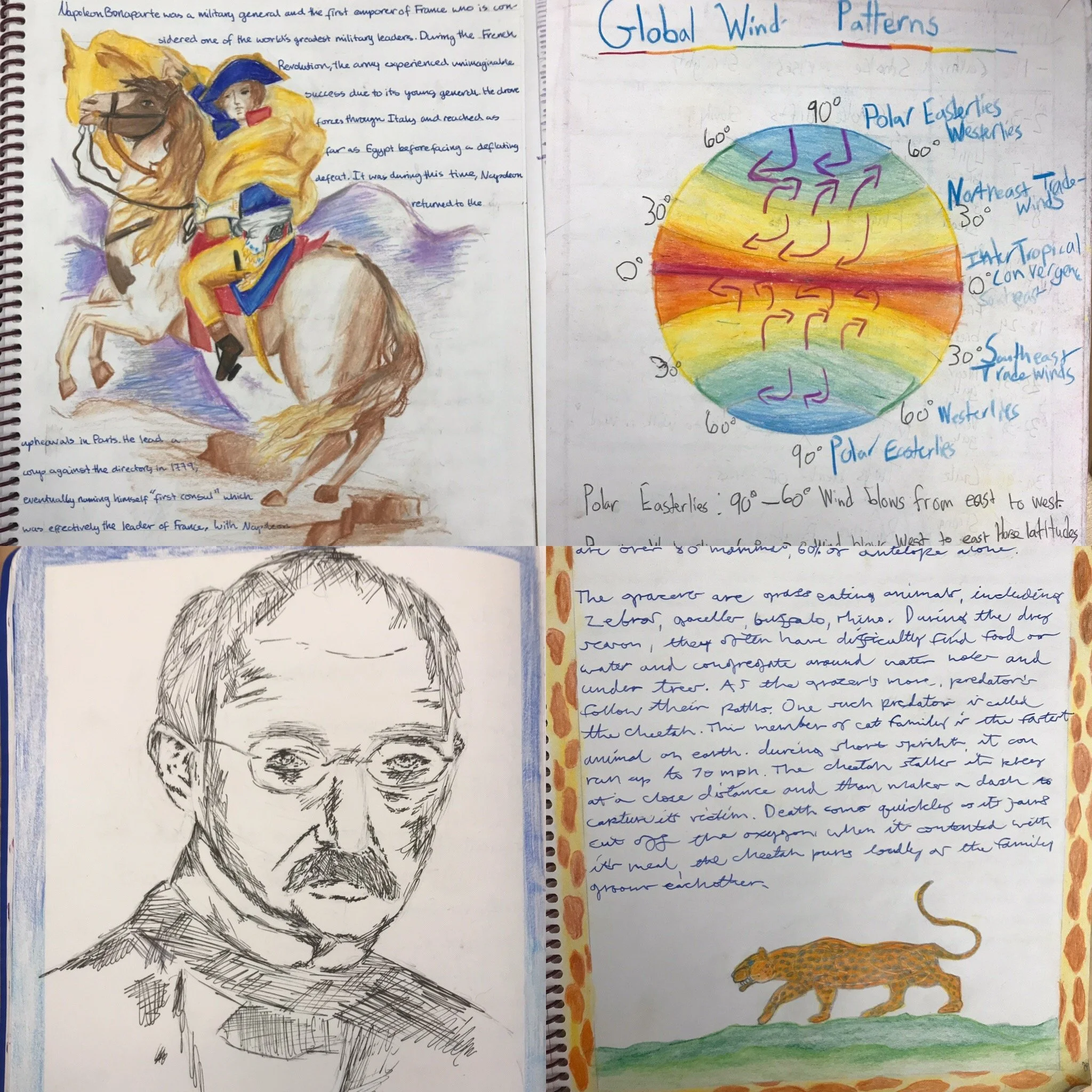
Pages from an eighth grader’s main lesson book.
Middle school stays nearly screen-free. Students learn to type via an online typing course, take a course in digital citizenship, and do a limited amount of guided online research. The majority of their school work remains experiential and in their own hands. They leave eighth grade understanding how technology works and, more importantly, how to use it wisely.
The Early Grades: Building the Foundation
Each block of study begins with a main lesson book that students create themselves, page by page. They learn to write in cursive and print, and children learn to read from words they have first written themselves. Math is practiced with real objects, movement, and pencil and paper. When students study a plant or a map, they draw it. When they research an animal or a country, they turn to reference texts.
We believe these years are best spent building attention, memory, and the patience to stay with something difficult. A math game on a tablet can hold a child's interest, and working a problem through by hand teaches them to hold their own. Those capacities make everything that comes later easier to learn, including technology.
Middle School: A Careful Introduction to Technology
By middle school, our students have spent years learning to focus, to think through problems on their own and with others, and to judge whether a source can be trusted. That's when we begin introducing technology, slowly and with a clear purpose for each step.
The work itself still happens by hand. Students keep creating their own main lesson books, and they write and solve problems on paper. Screens enter the curriculum in just a few planned ways:
• Cyber Civics teaches them how the digital world works before they spend much time in it.
• An online typing course gives students keyboard skills before high school.
• Guided online research, paired with books and reference texts, lets them practice finding reliable information on the internet
What Cyber Civics Covers
Cyber Civics is a digital citizenship curriculum written for middle schoolers. It helps students become thoughtful, responsible participants in digital life. Lessons cover protecting your privacy, spotting misinformation, understanding how apps are designed to hold your attention, and treating people online with the same respect you would in person.
More and more, the course also includes AI literacy. Last year, our middle schoolers had a guest speaker come speak to them about AI. Students talk about what these tools can do, where they get things wrong, and how to use them honestly in their own work.
Our students learn the ideas first. They also come away with words for things that can be hard to talk about at home, and a conversation about a group chat or a viral video goes better when your child already understands what's behind it.
Will a Low-Tech Childhood Leave My Child Behind?
No. The reality is, children pick up technology very quickly. And, Seacoast Waldorf School graduates go on to public and private high schools and later to colleges including Tufts, Vassar, Barnard, and Babson. They leave eighth grade able to type, and software skills come quickly to a teenager. Good judgment about technology takes much longer to develop, and that's where we put our time.
For more on how we think about academics, read Is Waldorf Academically Rigorous? on our blog.
Come See for Yourself
Curious what this looks like in a real classroom? Join us for Window on Waldorf on October 27 to see our Grades 1 through 8 program in action, no commitment required. You can also call our admissions office at 207-686-3140 to schedule a visit.
