
How is Waldorf different from other types of schools?
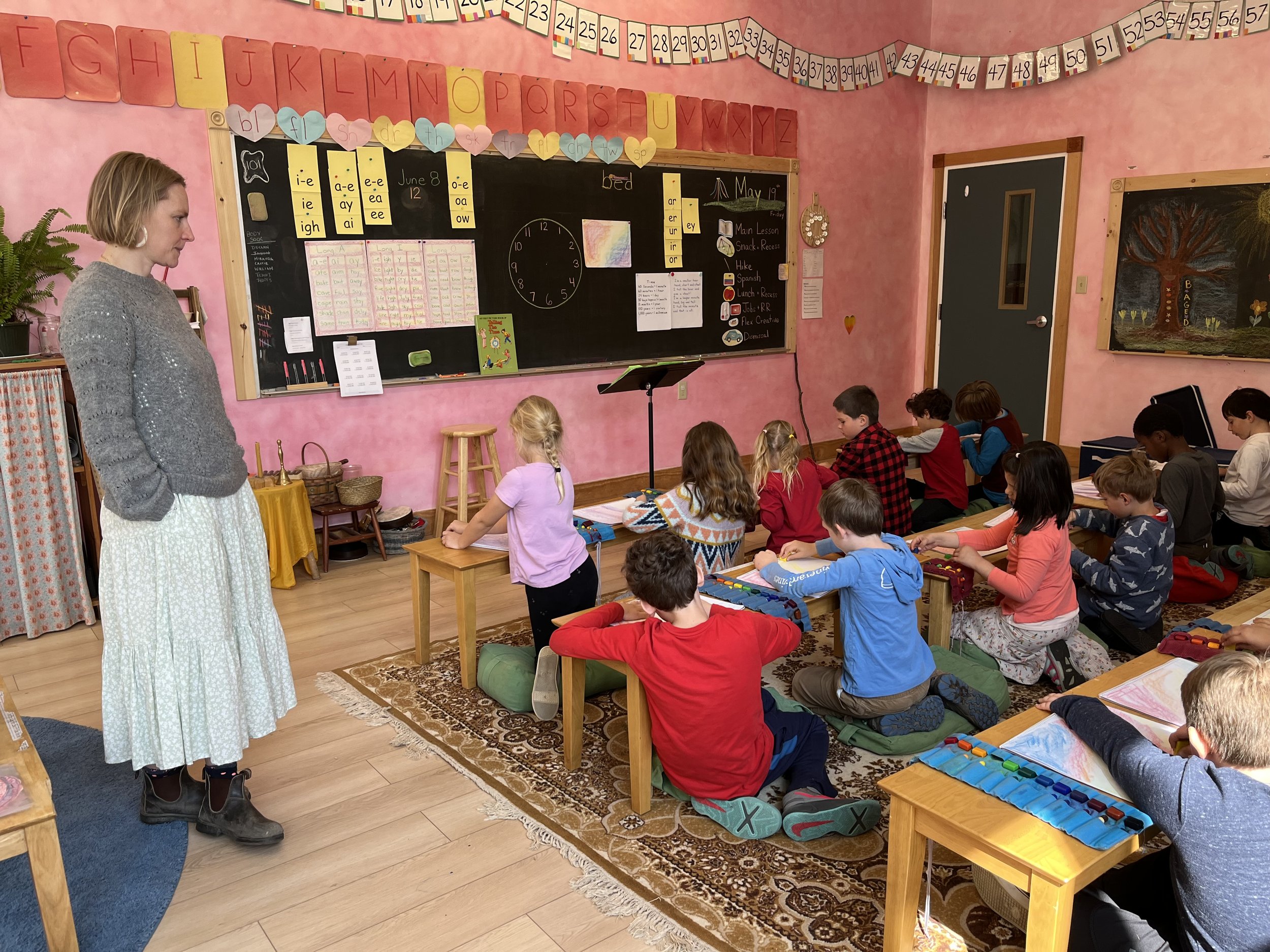
When parents look for alternative education to public school, the choices may seem overwhelming. There are so many options, including Waldorf, Montessori, Reggio Emilia, RIE and Forest School. How are these different from the public school model and from each other?
All of these philosophies have areas in common but also differ in some fundamental ways.
Waldorf education is developmentally appropriate and aims to inspire life-long learning in all students and to enable them to fully develop their unique capacities. Rather than hurrying children prematurely into academic tasks beyond their intellectual and emotional development, Waldorf protects childhood by introducing skills and concepts at a cognitively appropriate pace and developmental level. Arts are integrated in all academic disciplines for children from preschool through twelfth grade to enhance and enrich learning. Music, dance and theater, writing, literature, legends and myths are not simply subjects to be read about and tested. They are experienced. Through these experiences, Waldorf students cultivate their intellectual, emotional, physical and spiritual capacities to be individuals certain of their paths and to be of service to the world.
Teachers in Waldorf schools are dedicated to generating an inner enthusiasm for learning within every child. They often stay with the same cohort for years at a time and thus grow alongside one another, learning and teaching together, and enjoying a shared experience. There is no competitive testing, academic placement, and rewards to motivate learning and allows motivation to arise from within. This leads to joyful life-long learning.
Waldorf education is also independent and inclusive. It upholds the principles of freedom in education and engages independent administration locally, continentally and internationally. It is regionally appropriate education with hundreds of schools worldwide today.
Melissa Rocky Lewis has done a study on the differences between Waldorf, Montessori and Public education. She summarizes the differences in this way: Waldorf puts high value in art, imagination, and creativity and does not pursue academic instruction before the age of seven. Montessori puts high value in real life experience and an orderly environment and pursues early academics at a young age. Public education puts a high value on standard and measurable academics, with a focus on math and reading starting at age five.
She goes on to describe the similarities and differences in each education system.
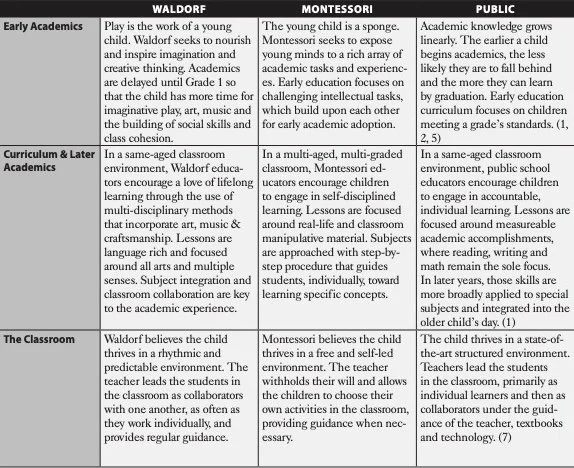
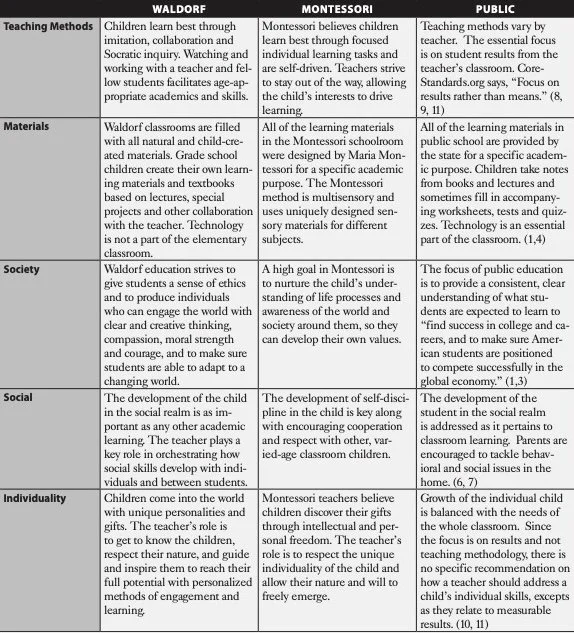
To look at the differences between Waldorf and the other alternative teaching philosophies, Jessica Rolph, CEO of Lovevery, has also created a summary of each philosophy in her article entitled “RIE, Montessori, Regio Emilia, & more - making sense of the methods”. She offers a brief description of each philosophy, as well as examples of how that works and what she likes and questions about each.
According to Rolph, the Waldorf education is all about creativity, imagination, and disconnecting from technology. Simple tools and toys (often made of wood and other natural materials) are believed to activate a child’s innate sense of wonder and creativity. Singing, dancing, art, oral storytelling, imagination games, and the use of those tools are hallmarks of Waldorf, as they all take precedence over technology, especially screen time.
The Montessori Activities and materials are used as a part of a child's “work”, and increase independence through hands-on discovery and play. Adults are urged to get out of the way, since children learn more from their experience than they do from direct teaching.
The driving force behind RIE (Resources for Infant Educarers) is respect - for the child, what they’re thinking and feeling, and what they can do with less instruction than you might think. RIE is about giving a baby or small child dignity through clear communication, independence, validation of feelings, and a recognition that they are already a person who deserves respect.
The Reggio Emilia philosophy is rooted in learning through open-ended play and free expression. The model is based on respect for the child, and for a concept known as the “hundred languages” - which refers to nurturing the many ways children express themselves. Every child has their own way of making sense of the world, and they need to have a lot of opportunities for free play to express themselves.
Lastly, Forest Schools, like a number of other outdoor-based approaches, are founded on the belief that immersion in nature promotes well-regulated children who are empowered to take risks (both physical and emotional), grow relationships, make choices, and practice independence in a natural setting.
For more information about all of these teaching philosophies, refer to Melissa Rocky Lewis’ article, “Comparing Waldorf, Montessori & Public Education” and Jessica Rolph’s article, “RIE, Montessori, Reggio Emilia, & more”.